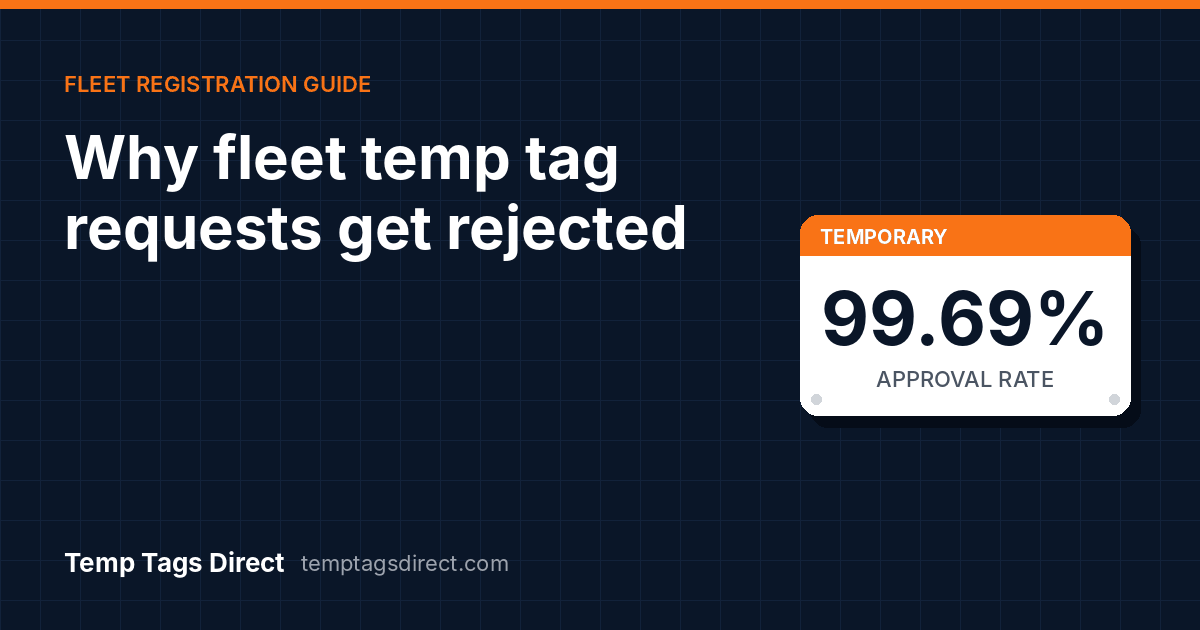
Most temp tag rejections come from a short list of causes: an invalid VIN or checksum, a model year that does not match the MSO, a tag already issued for that VIN within the limit window, a body type that does not qualify in that state, or tag limits being reached. Validating every VIN at submission catches these before processing. That is how Temp Tags Direct holds a 99.69% approval rate year to date (October 2026).
What does a rejection actually cost a fleet?
The classic loop is submit, wait, rejected, fix, resubmit. Each round can cost hours or a full day, and the vehicle is idle the whole time. Across a batch of hundreds of units, a small rejection rate turns into real downtime and staff time.
The most common rejection causes
1. Invalid VIN or failed checksum
A single transposed character makes a VIN invalid. The 17-character VIN includes a check digit, so many typos can be caught mathematically before anything is sent.
2. Model year does not match the MSO
The year submitted has to match what the manufacturer's statement of origin says. This is easy to miss on chassis and upfit vehicles where the build year and model year differ. We recently caught a 2025 vs 2026 year discrepancy on a Ford chassis before it ever reached the DMV.
3. Recent issuance on the same VIN
If a tag was already issued for that VIN within the limit window, a new one may be refused. This often happens when two teams order for the same vehicle.
4. Body type does not qualify in that state
Not every body type qualifies for every state's temporary registration. The VIN can be perfect and the request still fails.
5. Tag limits reached
States limit how many temp tags a vehicle can receive. Extensions need to be planned around those limits, which is why structured extension sequences matter.
6. Prior-tag conflicts
An existing tag on record, from another vendor or a dealer, can conflict with a new request.
How do you prevent rejections instead of reacting to them?
Move the checks to the moment of submission. In our portal, every VIN is decoded and validated as soon as it is entered, and every edge case we have encountered is built into the validation layer. If something will not qualify, the portal explains the specific reason immediately, so it is fixed once and submitted once.
| Cause | Caught at submission? |
|---|---|
| Invalid VIN / checksum | Yes, VIN decoder |
| MSO year mismatch | Yes, flagged against decoded data |
| Recent issuance for same VIN | Yes, limit window check |
| Ineligible body type | Yes, eligibility rules |
| Tag limits reached | Yes, pre-coded limits |
A quick pre-submission checklist for fleet teams
- Copy VINs from the MSO or title, not from a spreadsheet someone retyped.
- Confirm model year against the MSO, especially on chassis cabs and upfits.
- Check order history by VIN before ordering to avoid duplicates.
- Confirm the registration state is one covered for that vehicle type.
Frequently asked questions
Why was my temp tag rejected if the VIN is correct?
A correct VIN can still fail if a tag was already issued for that VIN within the limit window, the body type does not qualify in that state, the MSO year does not match what was submitted, or another edge case applies.
What is an MSO year mismatch?
It means the model year on the request does not match the year on the manufacturer's statement of origin. It is common on chassis and upfit vehicles and causes rejections.
What is Temp Tags Direct's approval rate?
99.69% year to date as of October 2026, across thousands of submissions.
Running 50+ registrations a month?
Get same-day, DMV-verifiable temp tags with portal and API ordering. A real person responds within one business day.
Get a fleet quote